
Accounting Firm Lead Follow-Up: How to Stop Losing New Clients Before Tax Season
Most accounting firms don't lose new clients because of price or fit. They lose them because the inquiry sat in an inbox while everyone was busy, and the prospect hired the firm that replied first. Good accounting firm lead follow-up is simple: decide who replies, how fast, and with what, then automate the first reply and the booking. November is the time to set it up, before the tax-season rush makes it impossible.
This post covers why inquiries go cold, what it costs, a plan you can start this month, and how an automated system keeps every new inquiry moving while your team is in returns.
"We'll get back to new inquiries after the 30th"
Every firm owner knows the feeling. It's March. The team is deep in returns. A web form comes in from a café owner with two locations who wants year-round bookkeeping and tax. It's a great fit. Someone flags it for later.
Later turns into April.
Capacity pressure is real. One CPA told Marketplace her firm gets calls "all the time" from people whose accountant just retired, asking if there's room, and they don't have it. In February 2026, a preparer told Accounting Today, "Our biggest concern is we don't have capacity on everybody." In the same story, another said, "I am getting more people finding me."
That's the problem in one sentence: new people keep finding you at exactly the moment you have the least time to answer them.
And it doesn't only happen in tax season. November and December bring year-end planning questions, new business owners setting up their books, and people who promise themselves "this year I'll get a proper accountant." Those inquiries often wait too, because there's always something more urgent.
What it costs you
Most owners don't track this, so start with a few questions:
How many new-client inquiries came in last February to April, by form, phone and email?
How long did the average one wait for a real reply?
How many turned into clients? How many never answered when you finally got back to them?
A few outside signals:
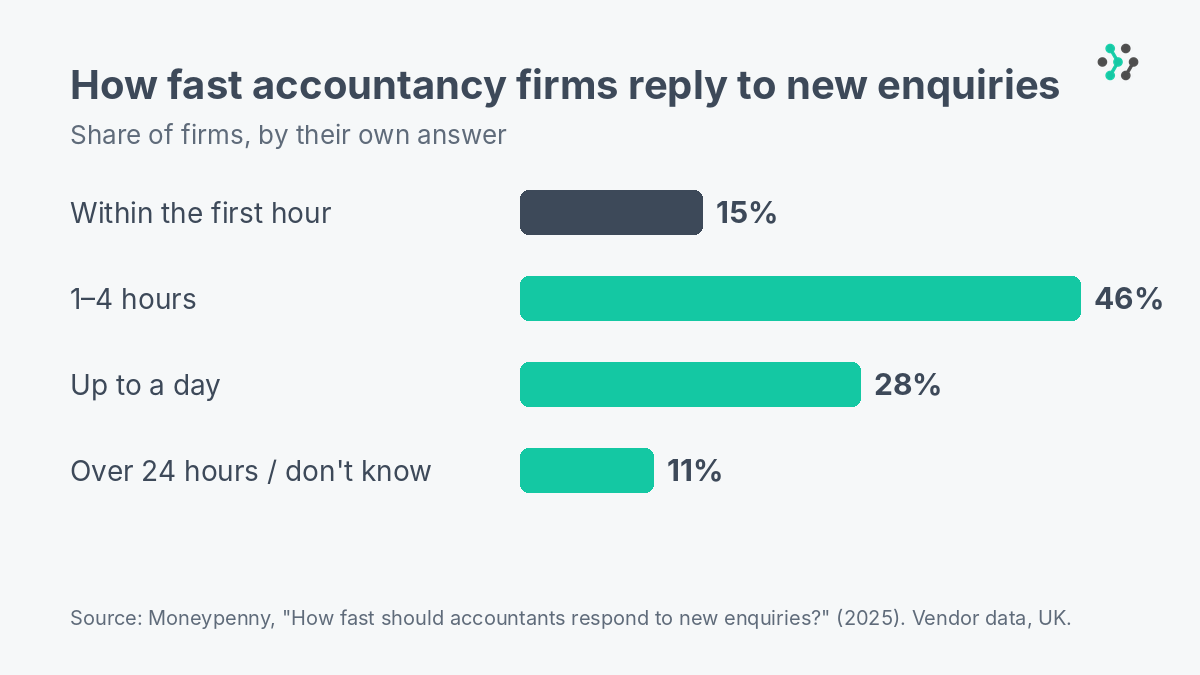
In a UK answering-service company's own survey, 15% of accountancy firms said they reply to new enquiries within the first hour, 46% within one to four hours, 28% take up to a day, and 11% take more than 24 hours or don't know. It's vendor data, so treat it as a direction, not a benchmark.
An older Harvard Business Review study of online sales leads found that companies that contacted a lead within an hour were nearly seven times as likely to qualify it as those that waited even one more hour. It's from 2011 and about online leads in general, not accounting firms.
Here's what it looks like from the prospect's side. One business owner wrote about contacting nine accounting firms. Three promised to call back. One called within half an hour, one a couple of hours later, and the third never did. That firm came off his list. It's one person's story from 2018, but most people who've shopped for an accountant will recognize it.
Then do your own math. A good year-round client isn't one tax return. It's monthly bookkeeping, a corporate return, personal returns for the owners, and often a referral or two, every year for many years. Multiply that by the inquiries that went quiet last spring.
What you can do this November, even without new software
The quiet months are your chance. Here's a simple intake plan.
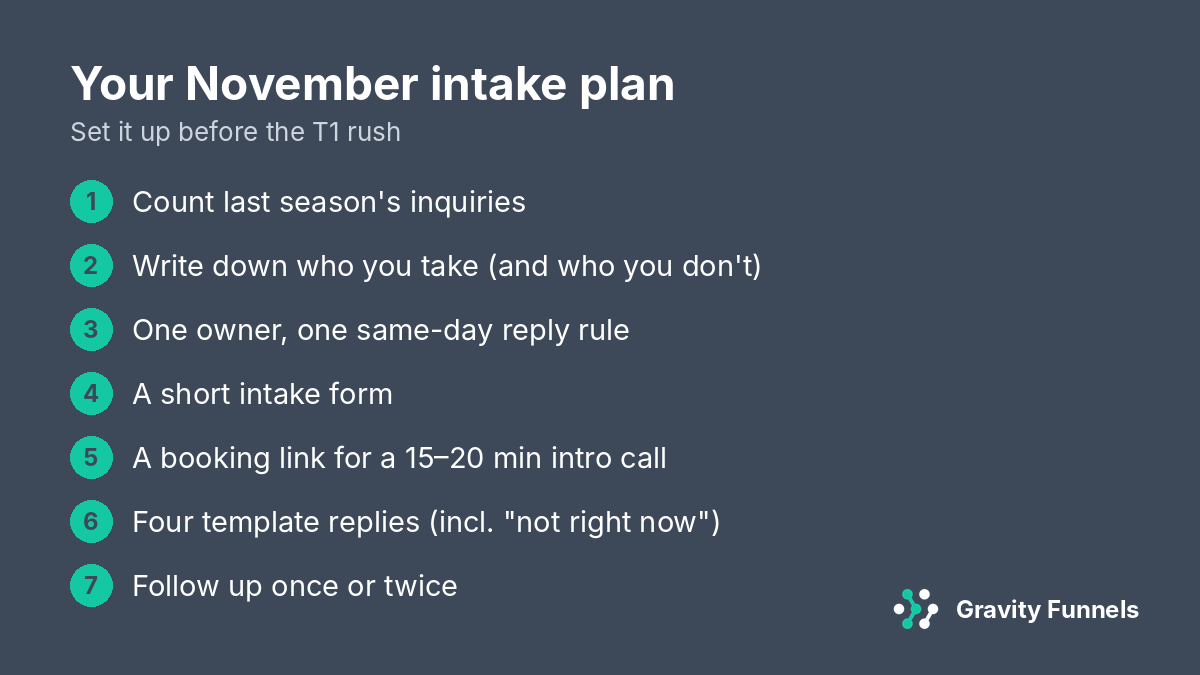
1. Count last season's inquiries. Go back through your inbox, web form and call log for February to April. Count new-client inquiries and note how long each waited for a reply. Twenty minutes, and you'll know how big the gap is.
2. Write down who you take, and who you don't. Business size, services, industries, personal-only or not. A clear list lets anyone on your team reply quickly, and a fast, polite "we're not the right fit, here's who might be" is still a good reply.
3. Give new inquiries one owner and one rule. One person (or one shared inbox) owns new inquiries, with a simple rule: every inquiry gets a real reply the same business day.
4. Use a short intake form. Ask what you actually need to decide: business or personal, services needed, number of entities, current bookkeeping software, deadline, best way to reach them.
5. Add a booking link. Let good-fit prospects pick a 15- or 20-minute intro call straight from your reply, instead of trading emails.
6. Write four template replies. "Great fit, book a call." "We'd love to help after April 30, can we follow up then?" "Not our specialty, here's a referral." "Thanks, a few quick questions first." Templates turn a 15-minute email into a one-minute reply.
7. Follow up once or twice. If a prospect doesn't book, a short check-in a few days later is often all it takes.
A quick note on the calendar: individual returns are due April 15 in the US and April 30 in Canada (June 15 for self-employed Canadians), and filing season opens in late January to February in both countries. Anything you set up after mid-February will be set up in a rush.
And one on texting and email. Replying to someone who just asked about your services is normally fine. Ongoing marketing messages are different: anti-spam and texting rules such as CASL in Canada and the TCPA in the US require consent, and every message should include your firm's name and an easy way to opt out. If you're unsure about a specific case, check with a lawyer.
How automated accounting firm lead follow-up works
Doing all of this by hand works until February. That's when a system earns its keep.
Here's what the Lead Rescue System can do for an accounting or tax firm:
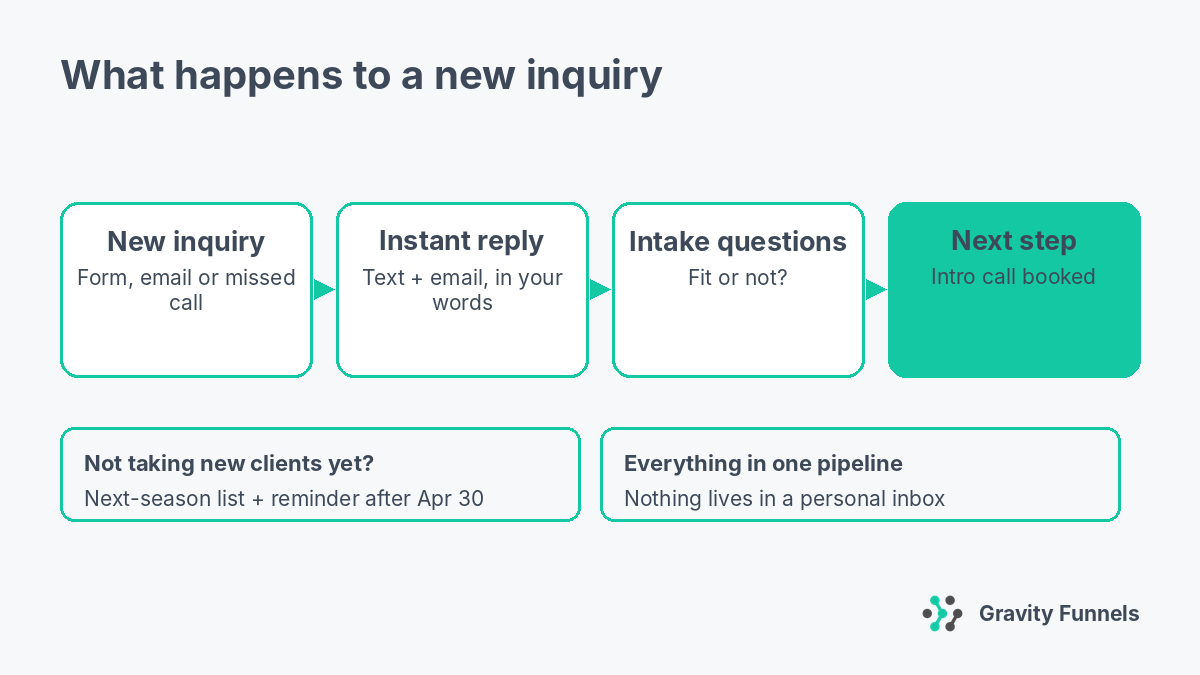
Reply to every new inquiry right away, by text and email, in your firm's words, whether it came from your website form, a missed call or an email.
Text back missed calls, so a prospect who couldn't reach you during a busy afternoon gets a reply instead of silence.
Ask your intake questions and record the answers, so you see who's a fit before anyone picks up the phone.
Offer your booking link for an intro call, straight into your calendar.
Follow up automatically if they don't book, and stop as soon as they reply.
Keep a "next season" list. If you're not taking new clients until May, the prospect still gets a polite reply and a reminder when you reopen, instead of nothing.
Put every inquiry in one pipeline, so nothing lives in someone's personal inbox.
With Conversational AI, website chat and text conversations get answered too, including evenings and weekends, when a lot of business owners finally sit down to sort out their books.
You stay in control: you decide who you take, what the replies say and when a person steps in. The system just makes sure no inquiry waits until "after the 30th." See how this works for accounting firms and tax firms.
FAQ
How fast should an accounting firm reply to a new client inquiry?
As fast as you reasonably can, ideally the same business day and within the hour when possible. The firms that reply first get the first conversation. An automatic first reply with a booking link covers the gap while your team is busy.
Should we stop taking new clients during tax season?
That's your call, and many firms do. But "not right now" should still be a reply. A quick, polite message and a reminder after April 30 keeps a good prospect warm instead of sending them to another firm.
Is it OK to text prospects who contacted us?
Replying to someone who asked about your services is normally fine. Ongoing marketing texts and emails need consent under rules such as CASL in Canada and the TCPA in the US. Always include your firm's name and an easy way to opt out, and check with a lawyer if you're unsure about a specific case.
What should a new-client intake form ask?
Only what you need to decide fit: business or personal, services needed, number of entities, current software, deadlines and how to reach them. Short forms get finished more often than long ones.
Want to see how many new inquiries are slipping through at your firm? → Book a Free Growth Audit
