How Plumbers Get More Google Reviews (Without Breaking Google's Rules)
The fastest way to get more Google reviews for a plumbing business is simple: ask every customer, the same day the job is done, by text, with a direct link to your review page. Then reply to every review you get. What you must not do is pay for reviews, offer discounts for them, or only ask the customers you know are happy. Google's rules forbid all three.
The rest of this post shows how to do it properly, and why winter is the best time to start.
"Our customers love us. So why do we only have 23 reviews?"
If you run a plumbing company, this probably sounds familiar. You fix the burst pipe at 7 AM. The homeowner thanks you three times at the door. They tell you you're the best plumber they've ever had.
And then nothing. No review.
It's not because they didn't mean it. It's because nobody asked them, or somebody asked at the wrong moment, or the link was hard to find. A busy homeowner with a wet basement isn't going to go looking for your Google Business Profile at 9 PM to write you a thank-you note.
So the reviews you do get come in slowly and randomly. Before long, your newest review is from June, and the company down the road has three times as many.
Why recent reviews matter when someone needs a plumber
When a homeowner searches "plumber near me" with water on the floor, they don't read your website. They look at the map results, compare star ratings and review counts, and call someone within a minute or two.
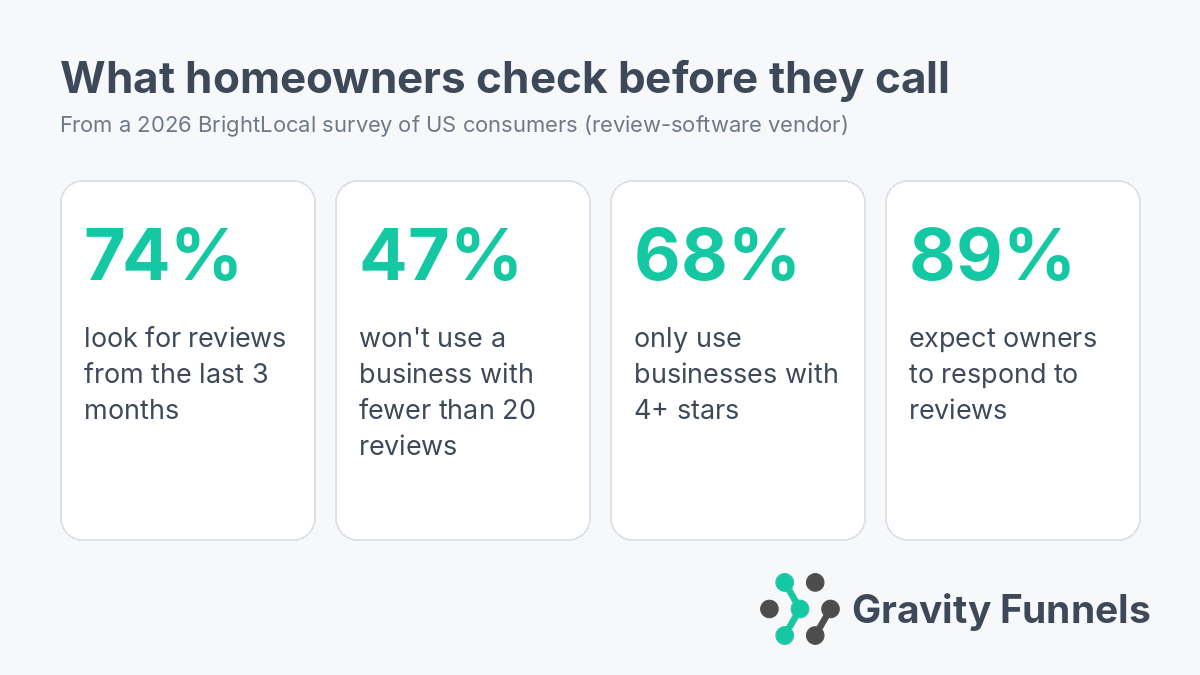
Here's what that comparison looks like from the customer's side. A 2026 survey of US consumers by BrightLocal, a review-software company, found that:
74% look for reviews written in the last three months
47% won't use a business with fewer than 20 reviews
68% will only use a business with four or more stars
89% expect business owners to respond to reviews
That's one survey, and it's US-only, so treat the exact numbers with some caution. But the direction is clear: a profile with a handful of old reviews looks less trustworthy than one with a steady stream of new ones.
Google says something similar about your visibility. In its own guidance on how to improve your local ranking, Google says local results are based mainly on relevance, distance and how well-known a business is, and that "more reviews and positive ratings can help your business's local ranking." Google also says there's no way to pay for a better local ranking. Reviews are something you earn.
So ask yourself:
When was your most recent Google review?
How many reviews came in during the last three months?
If a homeowner compared you side by side with your closest competitor tonight, who would look like the safer call?
Why winter is the best time to ask
Winter is when plumbing gets urgent: frozen and burst pipes, no hot water, backed-up drains in a full house over the holidays. It's also when you meet a lot of first-time customers, many of whom found you on Google in the first place.
That makes it the best time of year to ask for reviews, for three reasons:
Relief is fresh. Someone whose basement you just dried out is about as grateful as a customer gets.
They found you on Google. They know how reviews work and why they matter, because they just used them.
Volume is up. More jobs means more chances to ask. A habit you build now keeps paying off in the slow months.
If you only start asking in spring, you've let your busiest stretch of happy customers go by without a single review.
What Google allows (and what can get reviews removed)
Before you start asking, know the rules. Google's policy on prohibited and restricted content for Maps is clear, and it was tightened again in April 2026. In plain words:
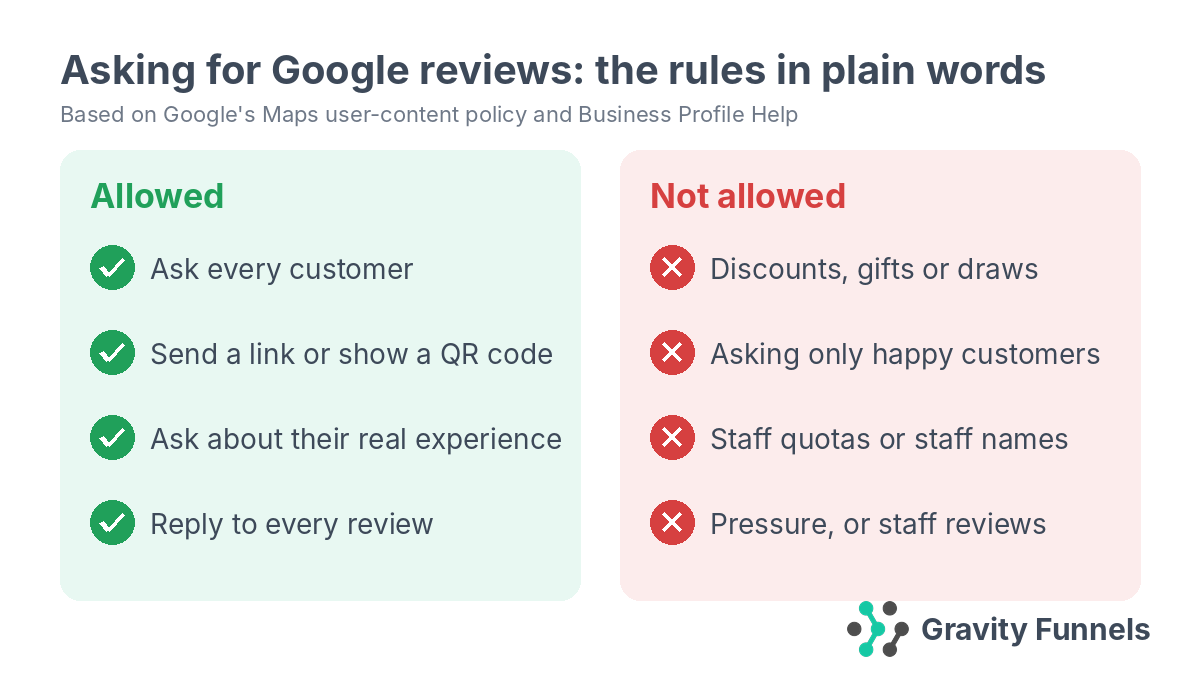
You can:
Ask customers to leave a review about their real experience.
Send them a link or show a QR code that takes them straight to your review page.
Reply to every review, good or bad.
You can't:
Offer anything in return. No discounts, free service, gift cards or draws. Google treats this as fake content, and it doesn't matter whether the review is positive or negative.
Ask only the happy customers. Google forbids "selectively" asking for positive reviews. That includes tools that ask "How did we do?" first and only send the 5-star people to Google. This is often called review gating.
Set review quotas for your techs or ask customers to mention a staff member by name. Both were added to Google's policy in 2026.
Pressure people on site to write a review before you leave, or tell them what to write.
Let staff, former staff or family review the business. Google treats that as a conflict of interest.
Google says content that breaks these rules will be removed. The compliant way is also the simpler way: ask everyone, the same way, and let them say what they want.
A simple review process for a plumbing company
You don't need a complicated system. You need the same few steps to happen after every job.
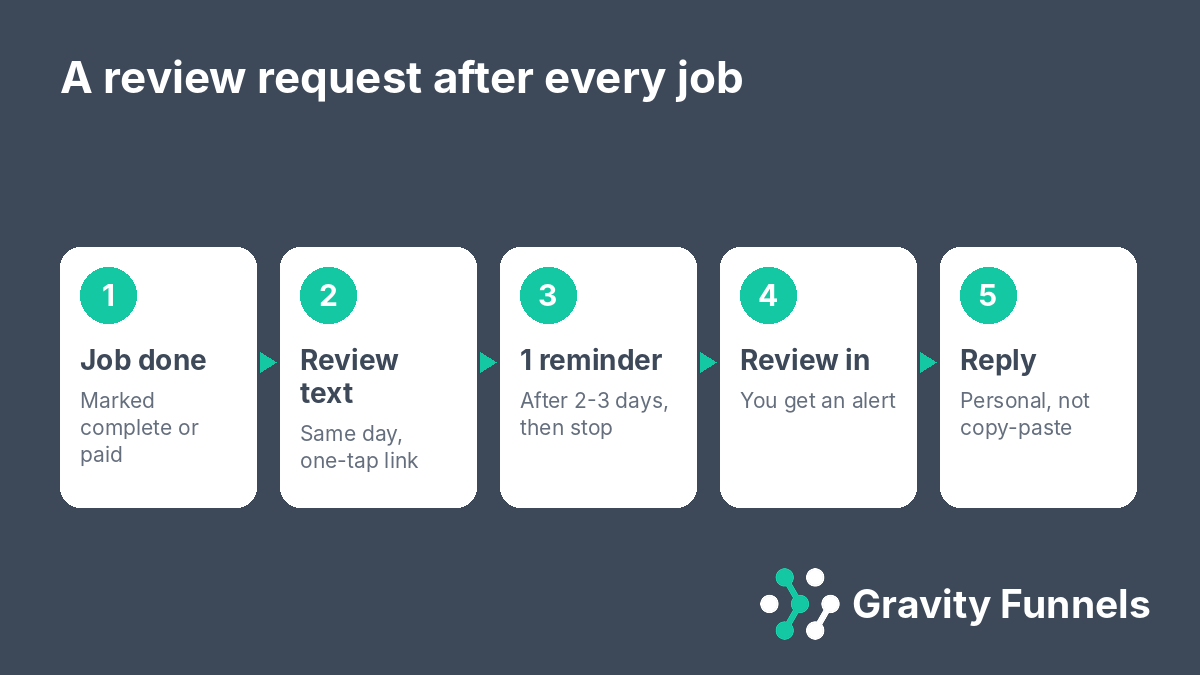
1. Ask within a few hours of finishing the job.
The best moment is the same day, while the relief is fresh. A short text works better than an email for most homeowners. Something like:
"Hi Sarah, thanks for having us out today. If you have a minute, we'd really appreciate a Google review about how it went: [link]. Thanks! — Mike, [Company]"
Note what it doesn't say: no "5 stars," no "mention Dave," no discount.
2. Make the link one tap.
Google lets you share a direct review link or QR code from your Business Profile. Put the link in the text, and the QR code on your invoices and the leave-behind card your techs hand over.
3. Send one polite reminder.
If they haven't left a review after two or three days, one reminder is fine. Then stop. Asking five times turns a happy customer into an annoyed one.
4. Ask everyone.
Every completed job gets the same message. Yes, that means you'll sometimes get a 3-star review. Google itself notes that a mix of positive and negative feedback often feels more trustworthy, and a thoughtful reply to a critical review can win you more trust than another 5-star one.
5. Reply to every review.
Thank people by name, mention the job when it makes sense, and keep it short. Avoid copy-paste replies: the same BrightLocal survey found generic or templated replies put off half of consumers. For a negative review, stay calm, acknowledge it, and take the details offline.
6. Check your numbers once a month.
How many jobs did you finish? How many review requests went out? How many new reviews came in? If requests aren't going out after every job, that's the leak to fix first.
How an automated system handles review requests
The process above works. The hard part is doing it after every single job when you're short-staffed, your techs are booked solid and it's minus 20 outside.
This is where automation helps. With a system like our Reviews AI, it works like this:
When a job is marked complete or paid, the customer automatically gets a friendly text with your direct review link.
If they don't leave a review, they get one polite reminder, then the system stops.
Every customer gets the same request, so you stay inside Google's rules (no gating, no incentives, no quotas).
When a new review comes in, you're notified, and a suggested reply is drafted for you to approve or edit, so every review gets a real answer.
You can see requests sent and reviews received each month, in one place.
Your team keeps doing the work. The system makes sure nobody forgets to ask.
It also connects with the rest of your customer follow-up. If you're also losing calls when you're out on jobs, our Lead Rescue System catches missed calls and slow replies, so the reviews you earn turn into more booked work. See how it fits a plumbing business on our plumbing industry page, or read our earlier guide to improving your local ranking on Google.
FAQ
Can I offer a discount or a gift card in exchange for a Google review?
No. Google prohibits offering anything of value in exchange for posting, changing or removing a review, and treats incentivized reviews as fake content that can be removed. This applies even if you don't ask for a positive review.
Can I only ask the customers I know were happy?
No. Google forbids selectively asking for positive reviews, and "review gating" tools that screen customers first fall into that. Ask every customer the same way.
How many Google reviews does a plumbing company need?
There's no official number. One 2026 US consumer survey (BrightLocal) found almost half of people won't use a business with fewer than 20 reviews, and most look for reviews from the last three months. A steady flow of new reviews matters more than one big push.
Should I reply to bad reviews?
Yes. Google recommends replying to reviews, and future customers read your replies. Stay calm, thank them, acknowledge the issue, and offer to sort it out offline. Don't argue in public.
Can my techs ask customers for reviews?
Yes, asking is fine. What Google now prohibits is giving staff a review quota or asking customers to mention a staff member by name. Keep the request the same for everyone.
Want to see how many reviews your business could be collecting each month, and where the requests are falling through? → Book a Free Growth Audit
