Garage Door Answering Service vs. Voicemail: What Happens to the Call You Missed
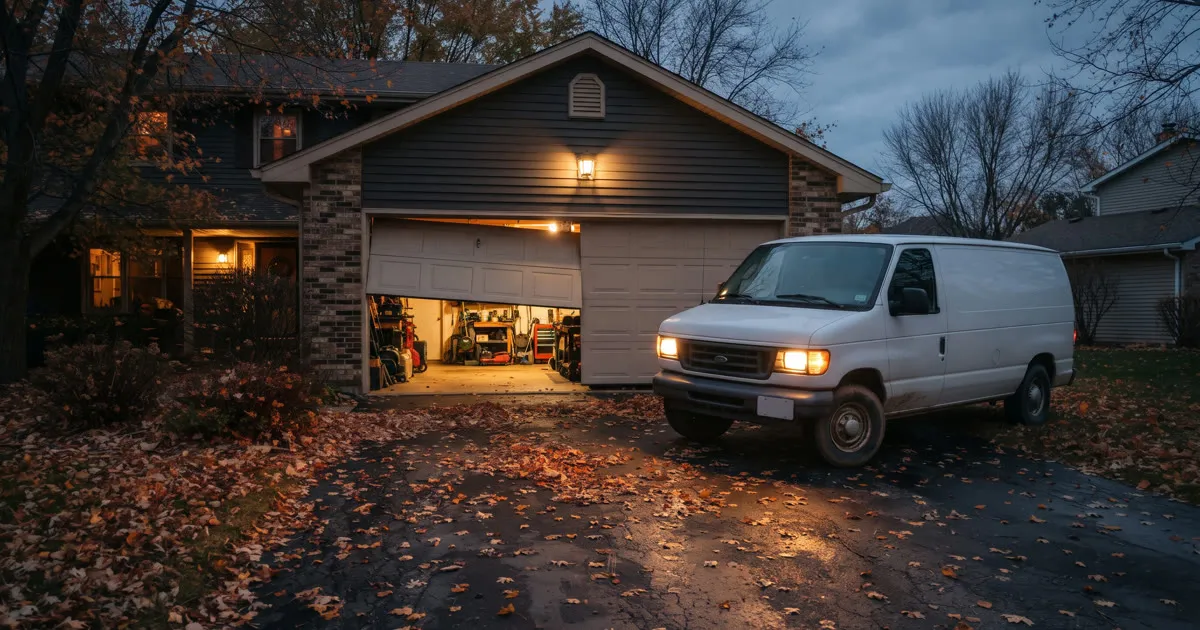
When a homeowner's garage door spring snaps, they don't leave a message and wait. They call the next company on the list. For a garage door business, voicemail is the weakest way to cover the phone. A garage door answering service, live or AI, or at minimum an automatic text-back, keeps that urgent call from booking with someone else.
Below: why these calls are different, what voicemail really costs, how the options compare, and what you can set up this week.
"I was on a ladder": the calls garage door companies miss
Ask any garage door owner when the phone rings, and the answer is usually "when I can't pick up." Your tech is up a ladder with a torsion spring. You're in the middle of an install. It's 7 PM and you're finally at dinner.
Those are also the moments the most urgent calls come in:
- A spring breaks and the door won't open, with the car inside.
- The door is stuck open and the homeowner can't leave the house unlocked overnight.
- The door came off its track after someone backed into it.
These callers aren't shopping around for the best price on a new door next spring. They need someone today, and spring work is a job for a trained technician, not a homeowner with a YouTube video. So they keep calling until someone answers.
That's the hard part. An urgent call doesn't really get "missed." It gets booked by someone else.
What a voicemail really costs a garage door company
It's easy to think of a missed call as one lost message. It's more useful to think of it as a job that went to a competitor.
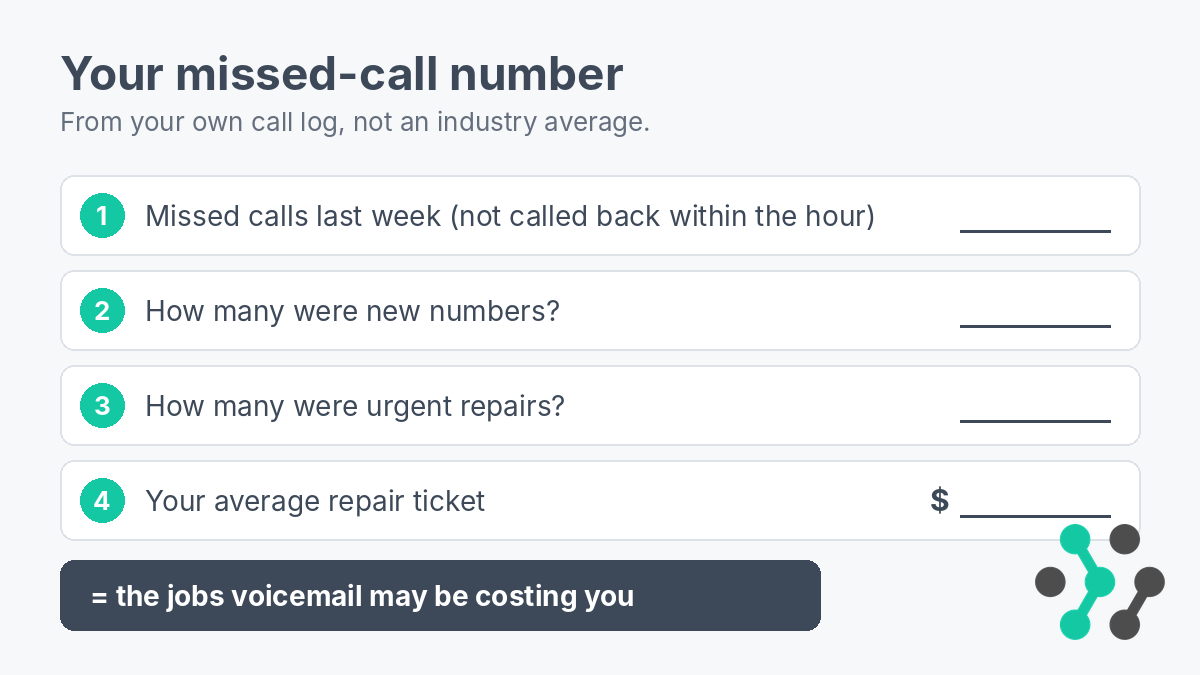
We won't quote you industry averages here. Most of the "missed call" statistics online come from companies selling phone software, and they don't agree with each other. Your own numbers are better. Try this:
- Open your phone system or cell carrier's call log and count missed calls from last week that never got called back within the hour.
- Look at how many of those were new numbers (likely new customers).
- Ask yourself how many of them were urgent repairs, and what your average repair ticket is.
Multiply those together and you have a rough weekly number. For most owners, it's the first time they've seen it written down.
There's a second cost if you advertise on Google. If you run Google's Local Services Ads, Google's own help page on ad rankings says it looks at "your responsiveness to customer inquiries and requests," and that "missed calls may negatively affect your responsiveness." In other words, missed calls can cost you the job and your position for the next search.
Answering service vs. voicemail vs. AI: the options compared
There's no single right answer. It depends on your call volume, your budget and how you handle emergencies. Here's how the common options compare for a small garage door company.
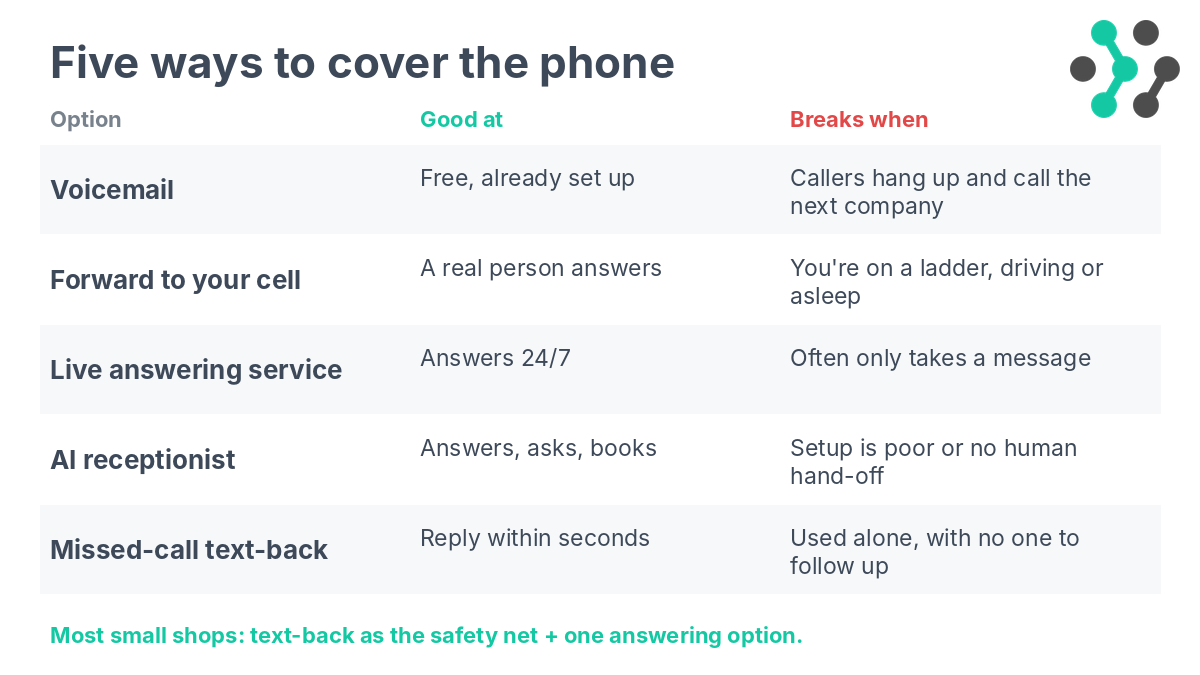
| Option | What it does well | Where it breaks |
|---|---|---|
| Voicemail | Free. Already set up. | Many callers hang up instead of leaving a message, especially with an urgent problem. You call back hours later, after they've booked someone else. |
| Forward to your cell | Cheap. The caller reaches a real person (you). | Only works when you can answer. On a ladder, on an install, asleep or driving, it's voicemail again, and you never get a break. |
| Live answering service | A real person answers 24/7 and takes a message. | Costs per call or per minute. Many services only take a message; they can't see your calendar, don't know your prices, and can't tell a broken spring from a squeaky opener. |
| AI receptionist | Answers every call, day or night, asks your questions, books into your calendar and alerts the on-call tech for real emergencies. | Needs good setup: your services, your service area, your rules for what's urgent. Some callers will still ask for a person, so there must be an easy hand-off. |
| Missed-call text-back | When a call isn't answered, the caller gets a text within seconds ("Sorry we missed you. What's going on with your door?"). Cheap and simple. | It's a safety net, not an answer. It works best combined with one of the options above. |
For most owner-operated shops, the practical setup is missed-call text-back as the safety net, plus either a live answering service or an AI receptionist for after hours and busy times. If you already use a live service and only get messages back, the gap is usually booking: the call is answered, but the job still waits for you to call back.
We wrote about the same problem for heating companies in after-hours answering for HVAC. The pattern is the same: the emergency goes to whoever picks up.
What you can do this week (even without us)
You don't need new software to make a real improvement. Start here:
- Pull last week's missed calls. Call back every one you haven't reached yet, today. Some of them may still need you.
- Change your voicemail greeting. Tell callers they can text this number for a faster reply, and say when you'll call back. "We call back within the hour, 7 AM to 9 PM" is better than "leave a message."
- Turn on text-back if your phone system has it. Many business phone systems and CRMs can send an automatic text when a call is missed.
- Write four triage questions. Whoever answers, a person or a system, should ask the same things:
- Is the door stuck open or stuck closed?
- Is a car trapped inside?
- Did you hear a loud bang, or can you see a gap in the spring above the door?
- What's the address and the best number to reach you?
- Decide what counts as urgent, and who's on call. A door stuck open at night is urgent. A noisy opener can wait until morning. Write it down so nobody has to guess at 9 PM.
- Give callers one safety line. If a spring looks broken, ask them not to force the door or try to fix the spring themselves, and tell them a technician is on the way or booked.
These steps cost almost nothing, and they'll show you how many calls you were really missing.
How an automated system handles urgent garage door calls
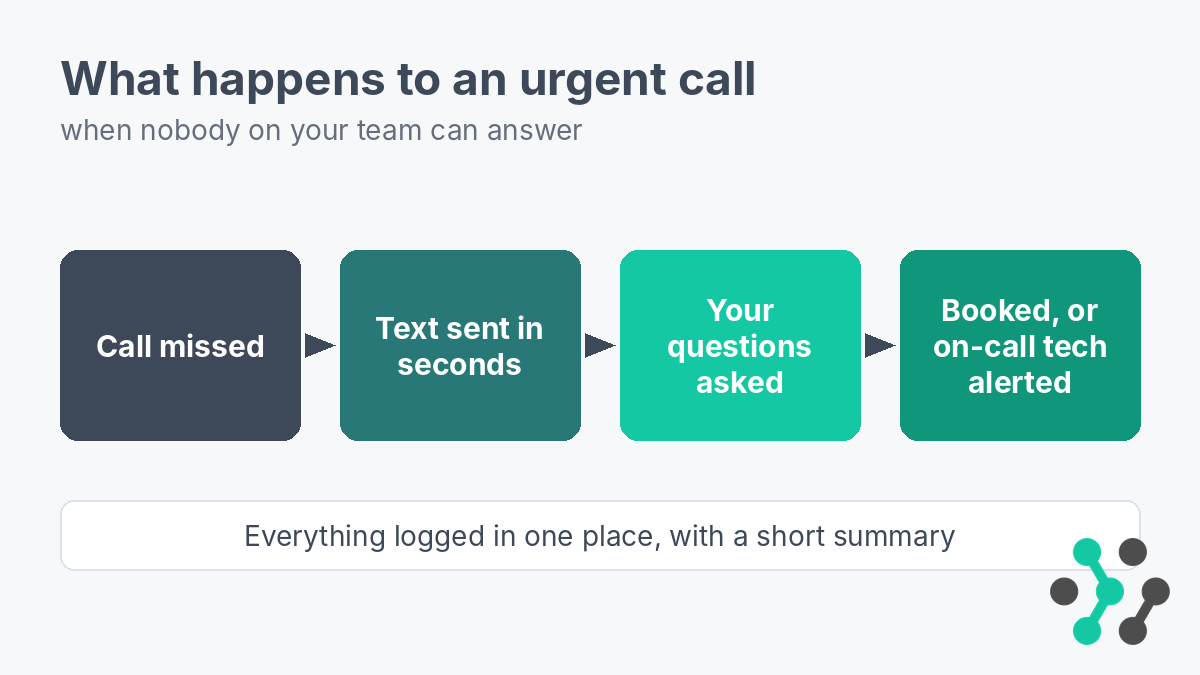
Once the basics are in place, automation keeps them running when you're busy. Here's how it works in the systems we set up for garage door companies:
- A call is missed. The caller gets a friendly text within seconds and can reply right there. That's the missed-call text-back in our Lead Rescue System.
- A call comes in after hours or while everyone is busy. An AI receptionist answers in your business's name, asks your triage questions, and explains your service area and next steps using the information you give it.
- The job gets booked. Routine repairs are booked straight into an open slot on your calendar. True emergencies, by your own rules, trigger an alert to the on-call tech with the details.
- Nothing is lost. Every call, text and booking is logged in one place, with a short summary, so you know what happened before you call anyone back.
You decide what it says, what counts as urgent, and when a real person takes over. It doesn't replace your team. It covers the phone when your team is on a ladder.
FAQ
Is an AI answering service the same as a live answering service?
No. A live answering service uses people, usually to take a message. An AI receptionist is software that answers the call, asks set questions, and can book the appointment into your calendar. Some businesses use both: the AI handles routine calls and a person handles anything unusual.
Will customers hang up on an AI receptionist?
Some will, especially if it sounds robotic or can't answer basic questions. That's why setup matters: it should use your business name, know your services and service area, and offer a person or a callback when the caller asks. A missed-call text-back catches anyone who hangs up.
Can it book jobs straight into my schedule?
Yes, if it's connected to your calendar or CRM. You set which job types it can book, how long each one takes, and which slots are open.
What about real emergencies at 2 AM?
You decide. Many owners don't want to roll a truck at 2 AM for every call. The system can book the first slot in the morning for most calls and alert the on-call tech only for the situations you define as true emergencies.
Do I still need voicemail?
Keep it as a last resort, but don't rely on it. Pair it with a text-back so callers who don't leave a message still get a reply.
Not sure how many calls you're missing? We'll look at your call flow, your Google profile and your follow-up, and show you where jobs are slipping away. → Book a Free Growth Audit
